


Conard Stone: Carving the Human Form in Wood

What can wood become in the hands of an artist?
For the late Jamaican sculptor Conard Stone, wood was more than a material. It was a way to explore the human form through shape, texture, movement and the physical act of carving.
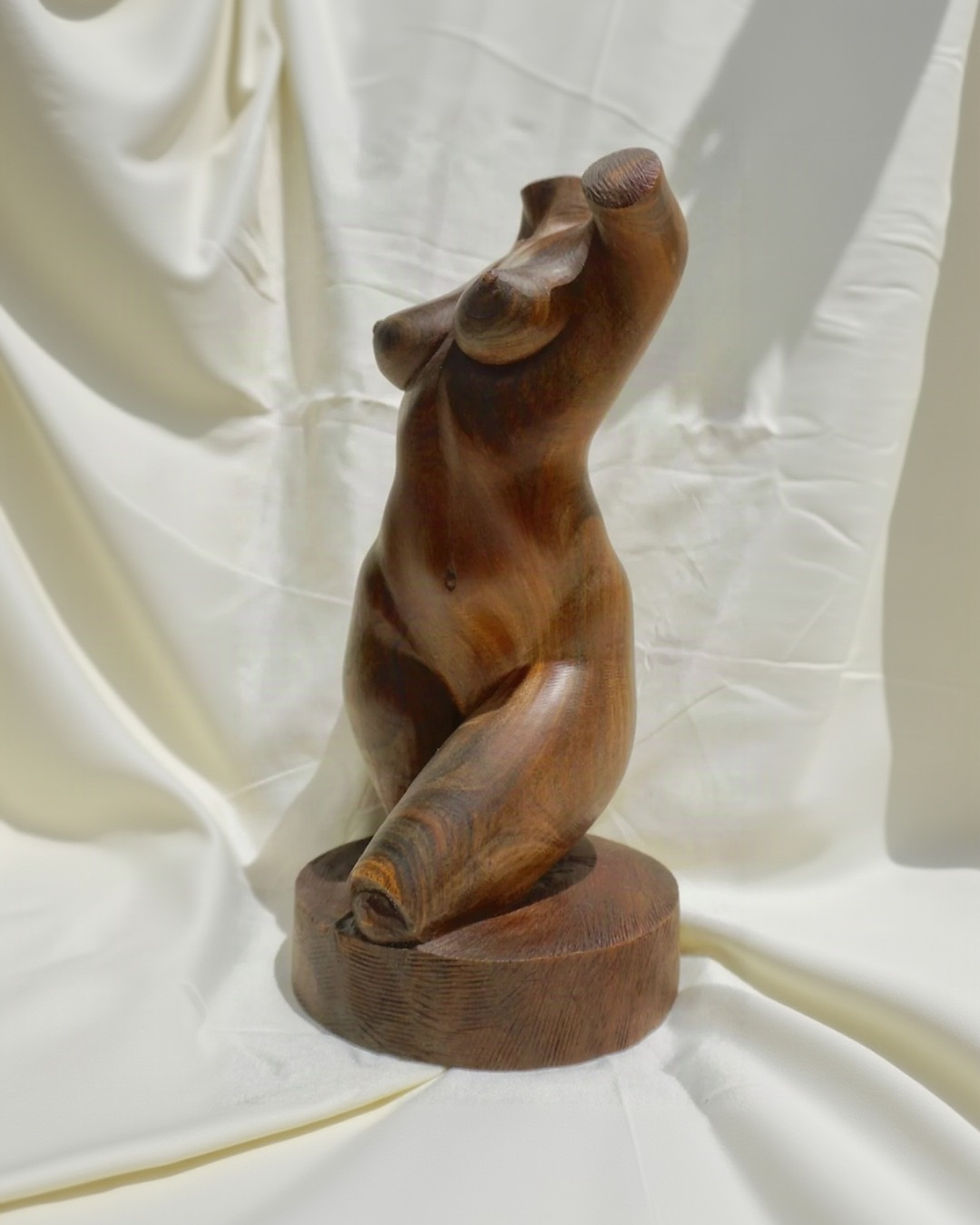
Working by hand, Stone transformed wood into expressive sculptural forms, revealing possibilities within a material that is both familiar and deeply connected to the Caribbean.
Finding the form in wood
Stone’s relationship with sculpture was shaped by an early experience of seeing what could be achieved with wood.
Reflecting on his introduction to the medium, he recalled:
“I was amazed that my teacher could get such three dimensional forms out of wood.”
That sense of discovery stayed with him.
There is something particularly compelling about sculpture made from wood. Unlike a manufactured material, wood already carries a history. It grew from the earth. It has grain, knots, variations in colour and texture. Every piece has its own physical character, and the artist has to work with those qualities rather than simply impose a form upon it.
For Stone, that relationship between artist and material became central to his work.
Wood and the Caribbean
Wood has long held an important place in Caribbean creative traditions.
Across the region, wood has been used for functional objects, architecture, craft, ceremonial pieces and carving. It has also become a medium through which contemporary artists engage with questions of culture, identity, history and place.
The Caribbean’s abundance of wood species has made the material familiar, but familiarity does not make it artistically simple.
In the hands of a sculptor, a piece of wood can become a body, a face, a gesture or an imagined figure. Its natural qualities can either disappear beneath the artist’s intervention or become an essential part of the finished work.
Stone’s sculptures demonstrate the latter.
The human form
Much of the power in Stone’s work comes from his engagement with the human figure.
Rather than simply reproducing the body, his sculptures explore how a figure can be suggested through carved surfaces and simplified forms. The marks left by the process matter. So does the grain of the wood.
The result is work that feels both physical and expressive.

There is also an intimacy to handmade sculpture that can be easy to overlook. Every cut, curve and surface represents a decision. Unlike an image produced instantly on a screen, the sculpture records the artist’s physical encounter with the material.
You can see the hand in the work.
Looking again at wood
Stone’s practice invites us to reconsider something that can otherwise seem ordinary.
Wood is everywhere in the Caribbean. We encounter it in trees, houses, furniture, tools and craft. Yet artists have repeatedly shown that familiar materials can hold unfamiliar possibilities.
Stone took that familiar material and used it to ask a much older artistic question:
How can the human form be expressed?
His answer came through carving.
Through wood, he explored the body not only as a physical form, but as something capable of carrying emotion, character and meaning.
A place in Caribbean sculpture
The story of Caribbean sculpture is not confined to one material, one island or one artistic tradition. It is a constantly evolving conversation between artists, materials, histories and places.
Conard Stone forms part of that conversation.
His work reminds us that Caribbean art can emerge from materials deeply rooted in everyday life, and that those materials can be transformed into something far more complex.
A piece of wood can remain recognisably wood while becoming something else entirely.
That is perhaps one of the enduring possibilities of sculpture: taking what is already around us and teaching us to see it differently.


Comments