


The Caribbean Doesn't Lack Talent. It Lacks Visibility Systems.

How much remarkable art has the world overlooked simply because it did not come from places already considered important?
This question lies quietly beneath many conversations about Caribbean art, even when it is not directly addressed. The discussion often begins with a familiar phrase. Caribbean artists are underrepresented. But what if the issue was never a lack of talent. What if it was something else entirely.
The problem with the word "underrepresented".
Underrepresented sounds neutral and even considerate. Yet it often hides a deeper assumption that visibility is something earned purely through merit.
It suggests that if Caribbean artists are not seen at the same scale as artists in global art centres, then something must be missing from the work itself.
But that framing avoids a more difficult truth.
Who gets fundedWho gets archivedWho gets documentedWho gets introduced to curators, galleries and institutions early enough to matter
These are not natural outcomes. They are shaped by systems that already have geography built into how they operate.
Talent has never been the issue
Across the Caribbean, there is no shortage of serious artistic practice.
There are artists working across painting, sculpture, photography, installation and performance whose work stands confidently alongside work shown in major international exhibitions.
The difference is not quality.
The difference is structure.
Talent is present in abundance. What is often missing is sustained access to funding, institutional support, critical writing and pathways into global circulation.
Without those systems in place, even exceptional work can remain contained within its immediate environment. Not because it lacks value, but because it lacks reach.
How visibility is actually built
The global art world is not only shaped by taste. It is shaped by access. For an artist to be consistently visible, there are usually multiple layers involved: early institutional recognition, inclusion in curated archives, gallery representation with international reach, critical writing that travels beyond the region and repeated exposure within established networks.
These systems tend to reinforce themselves. Places that already sit within global attention continue to generate attention. Places outside of that centre often have to enter through far more difficult routes.
This is where Caribbean art frequently exists. Not outside of talent, but outside of the infrastructure that distributes attention at scale.
Creating within uneven conditions
Many Caribbean artists are working within realities where resources are limited and unevenly distributed. Funding can be inconsistent, art institutions are often under resourced, education systems vary widely across islands and local markets are too small to sustain long term artistic careers on their own. And yet, the work continues.
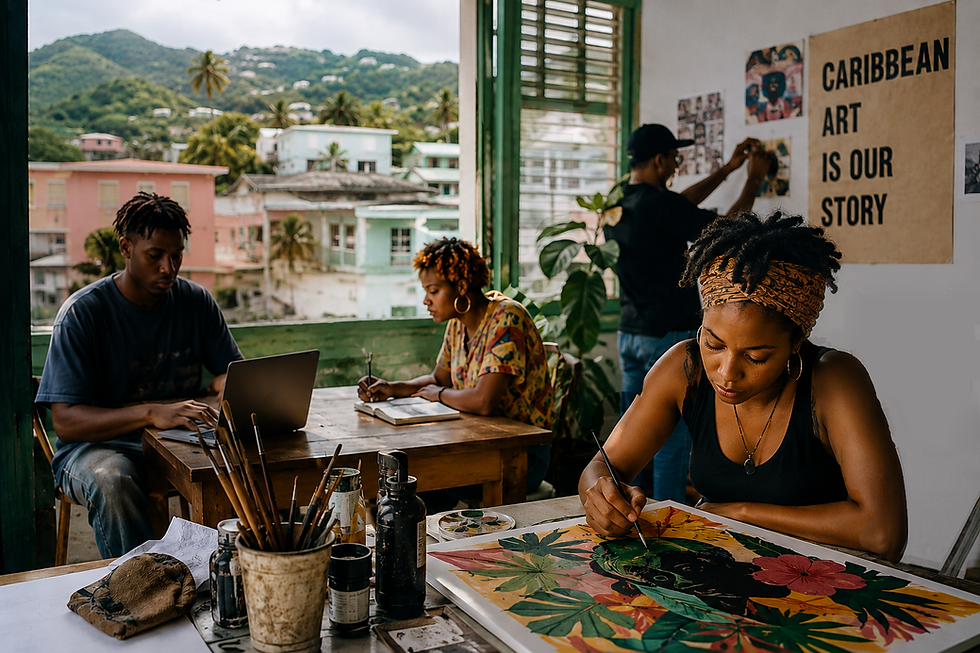
There are artists producing museum level work from small studios, shared spaces, bedrooms and diaspora networks spread across multiple countries.
They are expected to compete globally while often working without the same structural support that makes global participation sustainable.
The persistence of making
Despite everything, Caribbean artists keep creating. Not occasionally. Not as an exception. But consistently. That persistence says something important.
It suggests the issue was never whether the work exists. It is whether the systems in place are built to notice it early, support it properly and preserve it over time.
Rethinking visibility
If we shift the conversation, the framing changes completely. Instead of asking why Caribbean artists are underrepresented, we begin to ask different questions.
How is visibility actually produced? Who decides what enters the archive? Why do some regions enter global narratives through institutions while others enter through discovery or exception?
Visibility is not accidental. It is structured. And if visibility is structured, then invisibility is structured as well.
Closing reflection
The Caribbean has never lacked brilliance. What it continues to navigate is the absence of systems that consistently recognise, document and elevate that brilliance at scale. When we stop treating recognition as a simple outcome of talent, and start seeing it as something shaped by geography, access and institutional history, the conversation becomes clearer and more honest.
The work has always been there.
It still is.


Comments