


What Happens When an Artist Is Paid to Create?

What would happen if artists were not constantly preoccupied with survival.
If creativity was not something squeezed into evenings, weekends, or moments of exhaustion, but treated as real work that deserved stability.
This question is no longer hypothetical. In Ireland, it has been tested, measured, and proven.
In 2022, the Irish government launched the Basic Income for the Arts, a national pilot programme that provided artists, musicians, and creative workers with a guaranteed weekly income. In October 2025, following strong results, the programme was made permanent.
Two thousand creatives now receive a no-strings-attached payment of €325 per week, roughly €1,500 per month. The intention is simple but radical. To allow artists to focus on their creative work instead of juggling survival jobs, burnout, and uncertainty.
The outcome has been even more telling.']
An independent evaluation found that for every €1 invested, the programme generated €1.39 in economic value. This included increased creative output, higher tax contributions, and reduced reliance on social welfare. In other words, supporting artists did not drain public resources. It multiplied them.
What Stability Actually Does for Creativity
When an artist is paid consistently, something fundamental changes.
The constant pressure to monetise every idea immediately fades. The nervous system settles. Creative decisions are no longer driven by urgency, fear, or algorithms.
Artists begin to take risks again. They experiment. They research. They produce work that is slower, deeper, and more reflective. Not because they have been instructed to do so, but because they finally have the space.
This kind of creativity does not only benefit the individual. It benefits society.
Art created from stability carries more honesty, cultural memory, and emotional depth. It documents lived experience, challenges narratives, and imagines futures beyond what is immediately profitable.
Why This Matters for the Caribbean
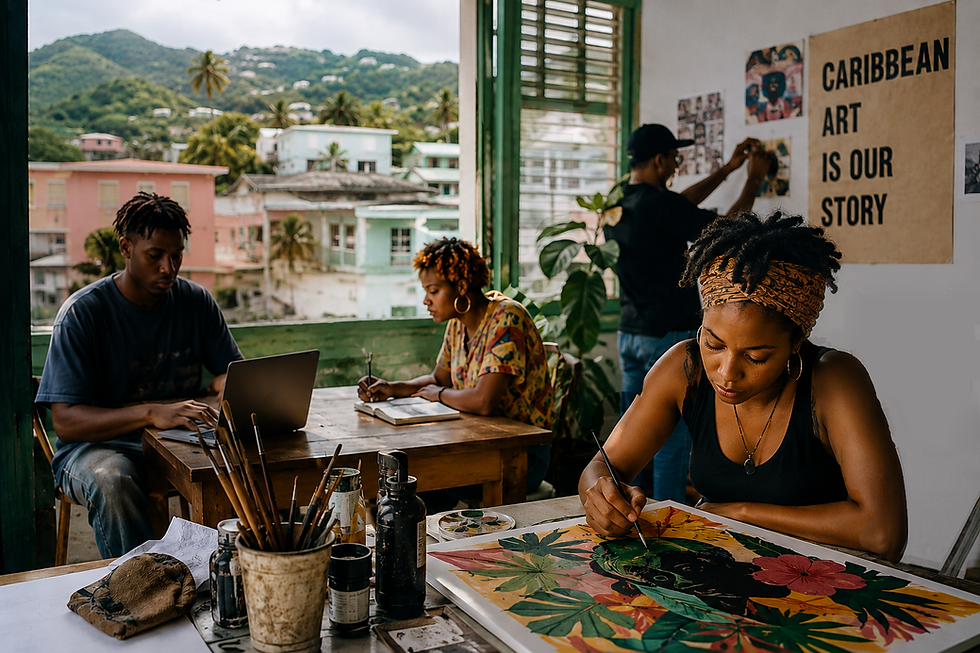
Across the Caribbean, creativity is everywhere. Music, visual art, dance, storytelling, performance, fashion, design.
Yet many Caribbean artists exist in a constant state of dual labour. One life for survival. Another for art.
We celebrate creative excellence globally, while locally offering little structural support to sustain it. Art is praised, but rarely protected. Creativity is expected to thrive without safety nets.
Ireland’s model matters because it reframes artistic support not as charity, but as infrastructure. Other countries, including Canada, the United States, and Scotland, have experimented with small or temporary schemes. Ireland is the first to implement a government funded, nationwide, and permanent programme of this scale.
It demonstrates a truth Caribbean societies already know but rarely formalise. Art is not a side activity. It is an economic, cultural, and social force.
A Different Vision Is Possible
Imagine Caribbean artists developing bodies of work without financial panic. Writers completing manuscripts without working multiple jobs. Musicians refining craft instead of chasing constant gigs. Visual artists planning long-term projects rather than surviving commission to commission.
This is not about removing ambition or effort. It is about removing unnecessary precarity.
Stable income does not dull creativity. It sharpens it.
Conclusion
Ireland’s Basic Income for the Arts offers a clear lesson. When society chooses to support artists, the return is cultural richness, economic value, and collective wellbeing.
At Caribalent, we believe Caribbean creativity deserves that same level of structural respect. Not as a luxury. Not as an afterthought. But as an investment in who we are and who we are becoming.
When you pay an artist to create, you do not buy their creativity. You free it.


Comments